Sunday, September 18, 2016

A fast Introduction to Managed Servers


Customers are increasingly aware of the requirement to back up their sites having a well managed server. Usually, the managed option often only reaches managing the operating program (and possibly hardware) from the server in question, we. e. updating the operating-system with the latest security patches (something that the "intelligent" control panel, for example cPanel, can handle by itself, mostly), latest package updates, and generally making certain the server works because intended.

In most instances, managed does not, nevertheless, cover application issues. This particular, however, is a essential point: You as the customer have to be sure that the server administration side of the enterprise speaks the same language since the application development side. There is nothing worse than an keen sysadmin updating a software program without consulting the designers who, incidentally, depend on the older version for the whole site to run efficiently. With nowadays globalisation, this could cause you additional suffering - often your developers are from the different company than your own ISP, and often these people (as is natural) may defend themselves in getting the blame. It will leave you as well as your enterprise crippled or impeded.

What do we recommend?

Don't save money on the sysadmin.
Make sure your sysadmin foretells your developers and understands what they require.
Make sure your sysadmin includes a basic understanding of your application in the event of emergencies.
Make sure your own staff: your sysadmin as well as developers coordinate updates as well as upgrades.
Make sure you've got a working test environment where one can run the updates and upgrades inside a sandbox to see in the event that afterwards things still work how they are expected to operate.
Have a teamleader organize your sysadmin(s) and developer(s), or even take this role on yourself.

How much could it be going to cost a person?

Fully managed packages differ in cost - the standard sysadmin packages that cope with the operating system only will up your financial allowance by anything between GBP 20 to GBP 200 monthly, if you want the actual sysadmin to be a fundamental element of your team and support the application as well (in conditions of coordinated server management), then the price could be more to the higher end of this range, but might possibly likewise incorporate some support for the applying as well already.

Who to employ?

Get someone with encounter. There are sysadmins available who have decades associated with experience and know the actual do's and dont's, and there are sysadmins that consider themselves divine just because they've been "into linux for two years". A sysadmin is not really someone who jumps in the first sight of a good available package upgrade as well as yum installs 200 dependencies to claim he's a system current. A sysadmin is somebody who understands the ramifications of a) upgrading as well as b) not upgrading. A sysadmin will weigh these benefits and drawbacks and explain them for you before making suggestions in regards to what to do. A sysadmin is somebody you trust to actually take this decision off your shoulder to help you run your business rather than having to worry if the next admin cowboy will blow up your server. A sysadmin is someone who knows not just how to keep something alive, but also how you can bring a failed system to life.

Owner of Woodstone - Home of Servers Alive Network Monitoring application

Sunday, September 11, 2016

How exactly does the HTTP Server Function?


The HTTP protocol is typically the most popular protocol in use within the TCP/IP arena. Every day vast amounts of people use it within their internet sessions, when they surf the net.

In this article I will explain how this server works for individuals who need or want to comprehend this mechanism.

(The HTTP server must be installed in computers which hold html pages for that browsers to display).

The HTTP server starts a 'listening' socket for incoming link with it. When a internet browser (the HTTP server's client) transmits a request, it processes the ask for and sends back a solution. The browser request appears like this:

"GET /index. html HTTP/1. 1

Web host: qms. siptele. com

User-Agent: Mozilla/5. 0 (Windows; Ough; Windows NT 6. 0; en-US; recreational vehicle: 1. 9. 2. 10) Firefox/3. 6. 10

Take: image/png, image/*; q=0. 8, */*; q=0. 5

Accept-Language: en-us, durante; q=0. 5

Accept-Encoding: gzip, deflate

Accept-Charset: ISO-8859-1, utf-8; q=0. 7, *; q=0. 7

Keep-Alive: 115

Link: keep-alive

Referer: "

The HTTP server actively seeks a file name "index. html" in the HTTP underlying directory and sends this back if exists or inform how the file does not is available - error code "404" as some people noted.

The request consists of several lines with significance:

The "Host" line informs the HTTP server whose host is within reference. This field allows the HTTP server to take care of several hosts (or domains) in a single server. It just accumulates this value and use the proper root directory with this host.

The "User-Agent" tells the actual server which browser is within use. In our case it's "Firefox" browser. This field doesn't have special importance, it just permits us to get statistics about the browsers percentage being used.

The accept fields inform the server concerning the browser capabilities. The server attempts in order to send back content how the browser can handle.

The "keep alive" tells the server how the browser wants to make use of the current socket for approximately 115 times for requests/responses.

The "Referrer" field is the most crucial information for Internet entrepreneurs. It tells the server that page the browser originated from. This information is logged and informs us such things as:

a. What search phrases where utilized in the search engine (like Google) to locate us.

b. Which advert of ours gets clicked on.

c. Which article/page points to the site generated this go to.

This information is invaluable. It tells us exactly how are marketing efforts performing. If we run ads searching engines for example we are able to know which ad is actually performing better then other people, and focus on this.

The first HTTP servers where effective at locating files and sending these phones the browsers. Later on the requirement to access databases arouse and delivered to the creation of "CGI" (Common Entrance Interface) programs. The CGI is actually a native program that runs through the HTTP server in a unique process environment, gets some request parameters in the server and processes this.

After the processing it returns the info to the HTTP server which sends it to the browser.

Having a native program running about the server opens many options towards the programmer. He can entry and process information within databases, create dynamic behavior from the system and open totally new ways of system abilities.

Opening the system additionally increased the vulnerability from the computer to hacking...

Following several penetration incidents, a brand new restricting set of rules happen to be developed for the server. The server now has privileges of the restricted account and team, so it could only run within the predefine directories allocated into it, and not access the whole system. Having restricted account also helps to ensure that an intruder gaining shell use of the server (after crashes the HTTP server) won't be able to see as well as utilize system information to achieve control over the pc itself.

There was a demand for managing a script language to relieve the developing time. This demand was clarified by company called "Zend" which developed a scripting vocabulary called "PHP" which means "Personal Home Page". After i say "scripting language" I am talking about a language that is actually interpreted line by collection at execution time. Such languages take additional time to parse and perform compatible to native programs (that simply need to be run), but the rapid improve in computer performance causes it to be irrelevant.

PHP gained a huge user-base and is among the top scripting languages being used today. To run this, the HTTP server will need a PHP interpreter in order to process it. When the HTTP server requested to take care of a PHP program this run the PHP interpreter like a CGI program, and this interpreter has got the PHP script and procedures it.

A new mechanism was invented to maintain information in the internet browser, which are called "cookies". Cookies are short quantity of information sent from the actual HTTP server and kept through the browser. The browser keeps these details and sends it each time it accesses the HTTP server. This information allows keeping state information for a long period. The information often consists of username and session -id so people do not have to fill their username and password each time they access the HTTP server. This is the way Gmail "remembers" the person and session that users have and permit them to open the correct Email page without requesting credentials every time.

Nowadays the HTTP server are extremely sophisticated. Web 2. 0 allows sending many requests towards the browser and get responses with no need to refresh the entire screen. This makes it simple to process information inside the actual page without affecting the entire page. This makes it easy and interactive to switch information quickly in websites like Facebook.

I have explained right here the operation and evolvement from the HTTP server. This description should give bird-eye overview concerning the way an HTTP server works and permit programmers to understand the reason why of creating things because they are.

Owner of Woodstone - Home of Servers Alive Network Monitoring application

Sunday, July 10, 2016

Server Monitoring Service: Ensuring Reliability instantly


Sometime in August this season, visitors to Belgium Occasions websites were greeted having a blank screen.

The website from the mighty Belgium Times obtained hacked, some say through Syrian hackers. The monitoring system which was supposed to transmit an alert of the DNS change failed to do this.

This underscores how essential a server monitoring program is. In the over case, server monitoring service must have continuously ensured service accessibility through proactive resolution associated with malfunctions and errors.

A server is really a system of computers, a mix of software and suitable computing devices that provides network support. Servers provide essential system, either to private users or the general public via internet.

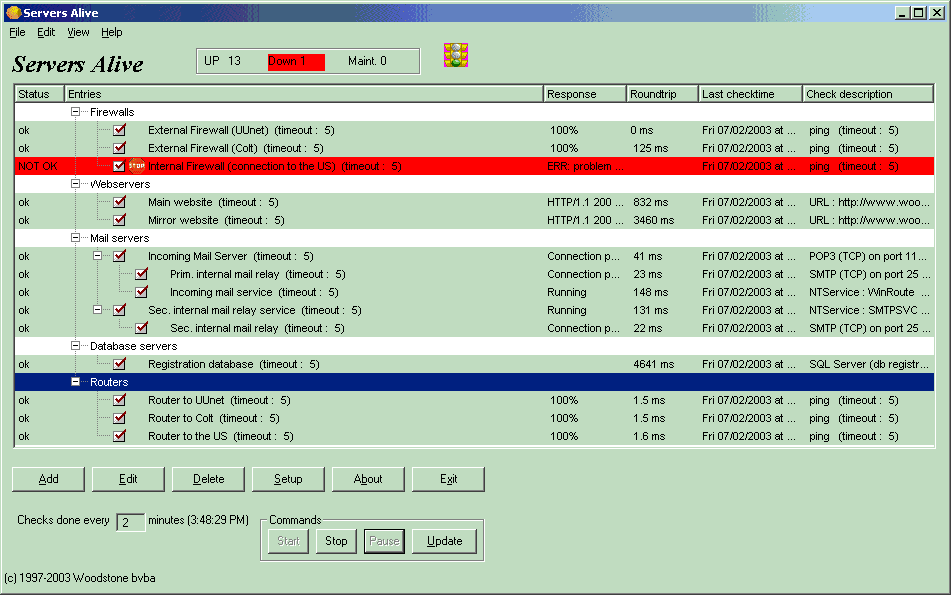
A server monitoring service monitors os's, associated hardware metrics, as well as critical operational services. A server monitoring software generally commences by giving minimalistic features and becomes heightened as and when required by clients. For instance, a web server may need sophisticated checks, such because:

• Responding to ping
• Reacting with proper content, whenever a web page is accessed having a known content
• Answering port 80

It is essential to understand that users often discover that a web server is down even though sever monitoring software recognizes it as active as well as healthy. This happens, when the software is unsophisticated. Such a scenario could be catastrophic to server hosting companies because system admins don't get alerts that the server is actually down until users grumble.

SaaS-based server monitoring assists in capturing and examining critical metrics, such because memory, process, CPU utilization, network utilization, and much more for Windows and Linux devices. SNMP monitoring software monitors bandwidth usage along with other device readings, such because memory, CPU usage, temps, and more.

Agent-based monitoring in the cloud helps in checking DNS, websites and programs, mail servers, and additionally resources within private systems. Monitoring private network may also be a necessity because workers, nowadays, use both internet and intranet applications within their day-to-day work.

In this kind of cases, cloud-based server monitoring service allows users to set up lightweight, auto-updating software on the internal networks, so that mission critical resources could be monitored.

Real Time checking

Today, dependability of servers is more important than in the past. Real time server checking enables clients to respond to problems instantly to improve reliability as well as quality of service.

For trade-based internet sites that require constant improvements, real time monitoring is vital. Businesses would not prefer to be directed to 404, when they must be getting emails and additional vital information.
 
Headquartered within bvba Woodstone, Schrieksebaan 146, 3140 Keerbergen, Belgium, LogicMonitor is really a leading SaaS-based IT checking solution offering companies server checking service that easily as well as cost effectively performs monitoring from the single pane of cup. The company has released SaaS-based SNMP monitoring software program for servers, Cloud, systems, applications, and storage.